In ecommerce, most brands are not lacking effort, they are lacking visibility. Orders are coming in, campaigns are running, inventory is moving. That is where a strong ecommerce operations tracking system for performance changes everything.
It is not about tracking more data. It is about tracking the right data, at the right time, with clear ownership. This guide breaks down how to build daily, weekly, and monthly tracking systems that turn your operations from reactive to controlled.
Why Do Most Ecommerce Tracking Systems Fail?
Most brands do not struggle because they lack data. They struggle because they have too much of it without structure. Every tool store backend, ads, email, fulfillment produces numbers constantly. But without clear decisions, those numbers become noise.
A functional ecommerce operations tracking system for performance depends on three things:
• Right metrics
Tracking only what impacts decisions
• Defined frequency
Knowing exactly when to review each metric
• Clear ownership
Assigning one person responsible for each level
Without these, tracking becomes inconsistent. And inconsistent tracking fails exactly when pressure increases.
What Should You Track Daily?

Daily tracking is about awareness not analysis. Some signals change fast enough that ignoring them for even a day can create operational issues.
Daily Metrics to Track
• Order volume vs. fulfillment rate
Ensures orders are moving efficiently, maintaining strong fulfillment performance
• Inventory alerts
Prevents stockouts and improves inventory control efficiency
• Customer support tickets
Spikes often signal product, delivery, or system issues
• Cart abandonment rate
Sudden changes may indicate checkout or payment problems
• Return initiation rate
Early warning of product or expectation mismatches
How Daily Tracking Works
Daily tracking should take 10–15 minutes.
You are asking:
Is today normal compared to yesterday?
If yes, continue. If not, investigate immediately. This builds awareness and supports continuous ecommerce process optimization.
What Should You Track Weekly?
Weekly tracking moves you from reaction to understanding. It helps identify patterns that daily tracking alone cannot reveal.
Weekly Metrics to Track
• Fulfillment accuracy
Measures how many orders are delivered correctly
• Order processing time
Identifies delays in warehouse or 3PL operations
• Ad performance efficiency
Ensures spend aligns with business targets
• Email and SMS performance
Tracks engagement trends
• Stock movement by SKU
Highlights fast-moving and slow-moving products
• Refund and dispute trends
Shows shifts in customer satisfaction
Weekly Tracking Goal
The key question is:
Is the operation performing as expected over time?
Weekly reviews strengthen your ecommerce backend workflow by identifying repeat issues early.
Consistency matters more than timing same metrics, same day, every week.
What Should You Track Monthly?
Monthly tracking is where operations connect to strategy. This is where you evaluate whether your systems support long-term growth.
Monthly Metrics to Track
• Gross margin by product
Reveals actual profitability
• Customer acquisition cost vs. lifetime value
Measures sustainability
• Inventory turnover rate
Tracks how efficiently stock converts to revenue
• Return rate by product/channel
Identifies hidden margin leaks
• Fulfillment cost per order
Shows operational efficiency
• Supplier performance
Evaluates consistency and reliability
Monthly Tracking Goal
Are we building a scalable, profitable operation? This level of tracking directly impacts both growth and inventory control efficiency.
How Do You Build a Tracking System That Sticks?
Most tracking systems fail not because they are wrong but because they are not used consistently. The real challenge is habit, not knowledge.
Practical Implementation Tips
• Keep dashboards simple
One screen, no scrolling
• Assign a single owner per level
Avoid shared accountability
• Start meetings with metrics
Build a data-first culture
• Document anomalies
Create a history of decisions and insights
• Limit metrics
Focus on 5–7 key numbers per level
A strong ecommerce operations tracking system for performance is simple, repeatable, and consistent.
What Mistakes Should You Avoid?
Certain mistakes quietly weaken tracking systems over time.
Common Mistakes
• Tracking too many metrics
Reduces clarity and focus
• Skipping reviews during busy periods
Creates blind spots
• Unclear ownership
Leads to missed insights
• Ignoring data inconsistencies
Leads to wrong decisions
• Overcomplicated dashboards
Discourages regular use
Avoiding these mistakes strengthens ecommerce process optimization and decision-making.
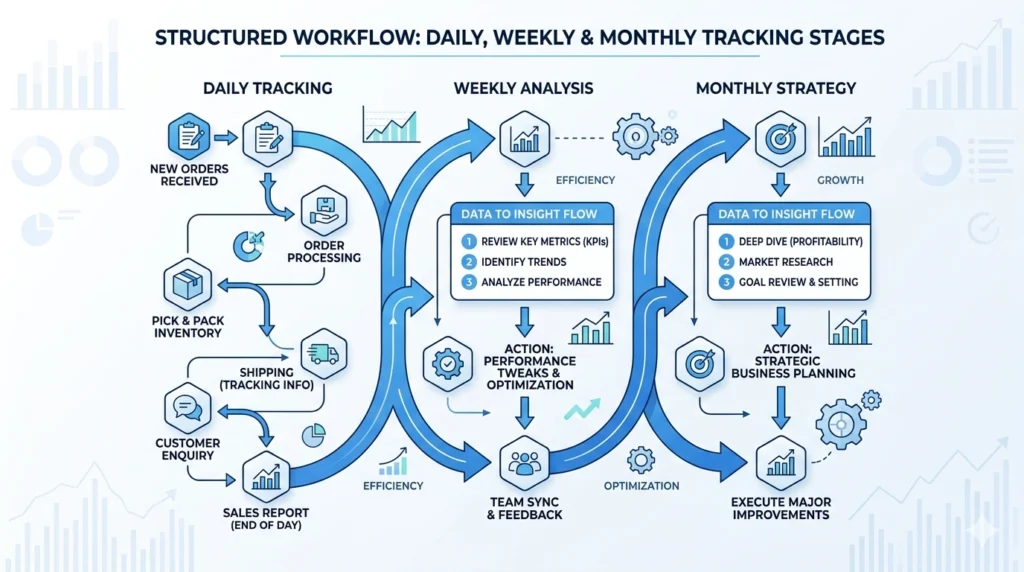
What Does an Effective Tracking Workflow Look Like?
Example Workflow
• Daily
Quick check for anomalies
• Weekly
Review patterns and identify issues
• Monthly
Make strategic decisions
At each level:
- Data becomes insight
- Insight drives action
- Action improves systems
This creates a reliable ecommerce backend workflow that supports scaling.
Conclusion
A strong ecommerce operations tracking system for performance does more than track numbers it changes how a business operates.
It turns uncertainty into clarity. It turns problems into early signals. It turns reactions into decisions. Start with daily tracking. Build consistency. Then layer in weekly and monthly reviews.
Because the goal is simple:
Know what is happening before it becomes a problem.
FAQs
1. What tools work best for ecommerce tracking?
Most brands use store analytics, dashboards, and fulfillment reports. The tool matters less than how consistently it is used.
2. How long should daily tracking take?
Around 10–15 minutes. It is a quick scan for anomalies, not deep analysis.
3. Should one person handle all tracking levels?
Not necessarily. Daily tracking can be delegated, while weekly and monthly reviews should involve decision-makers.
4. What if tracking data is inconsistent?
That indicates a system issue. Fix data accuracy before relying on insights.
5. How many metrics should be tracked?
Ideally 5–7 per level. Focused tracking is more effective than excessive tracking.