Scaling sounds exciting in theory. More orders, more revenue, more visibility. But in practice, growth rarely feels smooth. It feels like pressure.
Understanding how to scale ecommerce operations without system failure is not just about adding tools or hiring more people. It’s about building systems that can absorb growth without breaking. Because scaling doesn’t test your marketing it tests your operations.
Order volume increases, but backend systems don’t expand at the same pace. What once felt efficient at 300–500 orders a day starts slowing down at 1,500. Inventory mismatches appear. Fulfillment delays creep in.
Customer complaints rise not because demand is bad, but because the system underneath wasn’t designed to handle it. This is where most ecommerce brands struggle.
Why ecommerce backend systems Break Under Scale
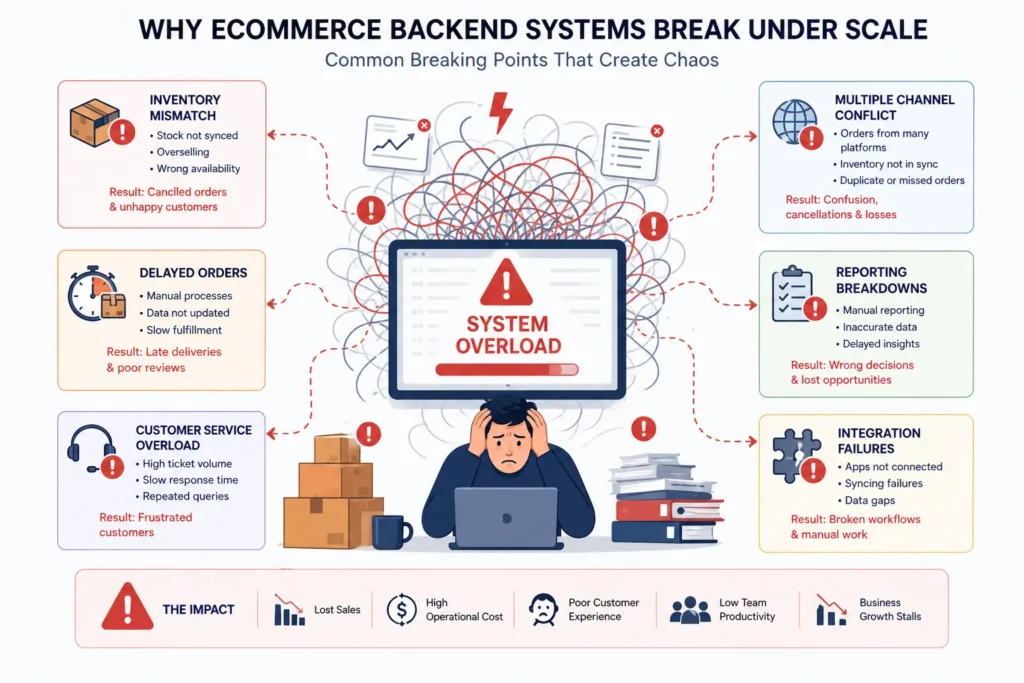
Most founders assume systems fail because they’re poorly built. That’s rarely the full story.
In reality, most ecommerce backend systems break because they were designed for a smaller version of the business. Simpler workflows. Fewer SKUs. Single-channel sales. As complexity increases, these systems hit limits.
Common breaking points include:
• Multi-channel expansion
Selling on your website is one thing. Adding marketplaces, retail, and wholesale introduces syncing challenges. Orders, inventory, and customer data start drifting across platforms.
• Inventory complexity
Manual or semi-automated tracking works at 100–200 SKUs. At 1,000+, it creates delays, errors, and overselling.
• Fulfillment strain and growing ecommerce fulfillment challenges
Your 3PL or in-house team may handle current volume well — until a sudden spike overwhelms operations.
• Customer service overload
Ticket volume grows faster than expected. Without automation, response times slow down, affecting experience.
• Reporting breakdowns
Manual reporting becomes unreliable when transaction volume increases.
Scaling exposes every weak point at once.
The Principle: Infrastructure Before Volume
The most important rule in how to scale ecommerce operations without system failure is simple: Build infrastructure one step before you need it.
For example:
• If you’re handling 1,000 orders/day, prepare for 3,000
• If your catalog has 300 SKUs, design systems for 800
This applies across:
• Order systems
• Fulfillment
• Customer service
• Internal processes
Scaling without preparation creates chaos. Prepared systems create control.
Building scalable ecommerce systems (Not Just Adding Tools)
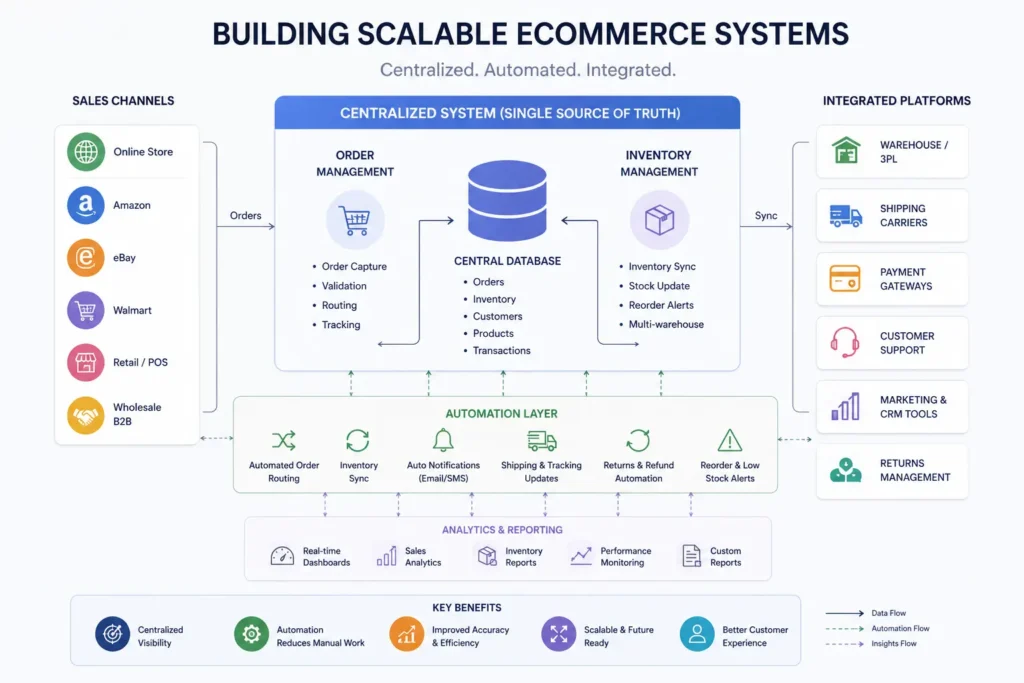
Most brands don’t design systems, they accumulate them. A returns tool here. A CRM there. A shipping app. Over time, this creates fragile systems. Scalable ecommerce systems are intentional.
To build one, you need clarity:
• When an order is placed → what happens next?
• How does inventory sync across platforms?
• What triggers fulfillment?
Key principles:
• Centralized data flow
• Minimal manual work
• Backup processes for failures
• No single point of failure
The goal is not complexity it’s reliability.
The 3PL Factor and ecommerce fulfillment challenges
Fulfillment is where scaling pressure shows up first.
Ignoring 3PL limitations leads to serious ecommerce fulfillment challenges:
• Delayed shipments
• Order backlogs
• Higher error rates
To scale effectively, align early:
• Confirm capacity limits
• Plan for peak volumes
• Understand pricing changes
• Review SLAs during high demand
Your 3PL is not just a vendor it’s your backend engine.
Integration Architecture: The Real Backbone
Your backend is only as strong as its integrations.
Poor integration leads to:
• Inventory mismatches
• Delayed orders
• Data inconsistencies
To fix this, define clear flows:
• Order → OMS → 3PL
• Inventory → Warehouse → Channels
• Returns → System → Inventory
When learning how to scale ecommerce operations without system failure, integration clarity is non-negotiable.
Why shipping performance Matters More Than You Think
Shipping is not just logistics it’s a performance metric.
Poor shipping performance creates:
• High WISMO tickets
• Increased returns
• Customer dissatisfaction
To improve:
• Provide real-time tracking
• Set accurate delivery expectations
• Monitor carrier efficiency
Better shipping performance reduces pressure across the entire system.
Stress Testing Before Scale Happens
Most brands don’t test systems until they break.
Instead, ask:
What happens if orders increase 5x tomorrow?
This reveals:
• Fulfillment bottlenecks
• System delays
• Support limitations
Fix these early to avoid breakdowns later.
The Hidden Role of Team Structure
Even the best systems fail without proper team alignment.
Scaling issues often come from:
• Lack of documentation
• Dependency on individuals
• Inconsistent workflows
Fix this by:
• Standardizing processes
• Training across teams
• Reducing manual dependency
Systems should support people not rely on them.
Avoiding Overengineering While Scaling
There’s also a risk of building too much too early. Not every brand needs enterprise systems at the start.
Balance is key:
• Avoid underbuilding → leads to failure
• Avoid overbuilding → wastes resources
Focus on systems that grow with you.
Conclusion
Scaling is not just about growth, it’s about stability under growth. Every backend system has a limit. Every process has a breaking point.
Understanding how to scale ecommerce operations without system failure means identifying those limits early and expanding them deliberately.
The brands that scale successfully are not the ones growing the fastest they are the ones growing the most sustainably. Because in ecommerce, growth without operational strength doesn’t lead to success. It leads to breakdown.
FAQs
1. What is the biggest issue in scaling ecommerce backend systems?
Inventory syncing and order management failures are the most common issues in ecommerce backend systems during growth.
2. How do scalable ecommerce systems help growth?
Scalable ecommerce systems handle higher volume without increasing errors, delays, or manual work.
3. Why is shipping performance important in scaling?
Poor shipping performance increases returns, customer complaints, and operational pressure.
4. What are common ecommerce fulfillment challenges?
Delays, capacity issues, and inventory mismatches are key ecommerce fulfillment challenges.
5. What is the best way to scale without system failure?
Prepare infrastructure early, automate workflows, and continuously optimize operations.