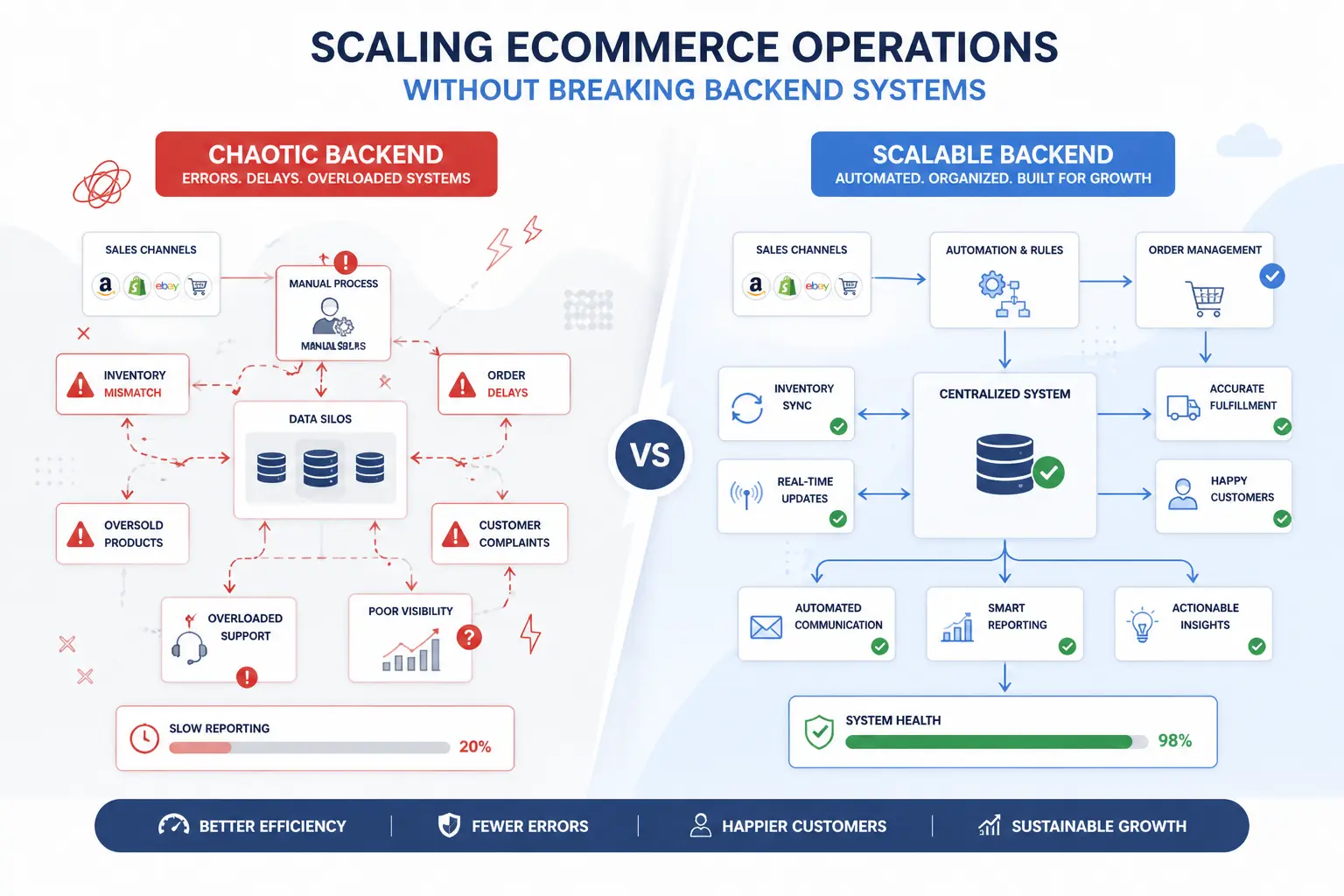
In the race to scale, most ecommerce brands obsess over marketing, product, and customer acquisition. But growth does not fail on the front end. It breaks in the backend. Orders start slipping. Inventory stops matching reality.
Customer experience becomes inconsistent. What looked like growth momentum turns into operational stress. This is where operational discipline in ecommerce business becomes the difference between scaling and stalling.
It is not about being rigid. It is about building systems that hold up under pressure. This guide breaks down what it actually means, why it matters, and how to build it before growth exposes the gaps.

What Is Operational Discipline in Ecommerce?
At its core, operational discipline in ecommerce business is the ability to run consistent, repeatable, and reliable systems regardless of scale. It is what allows a brand to handle 100 orders and 10,000 orders with the same level of control.
Think of it like infrastructure:
- The front end attracts demand
- The backend decides whether you can handle it
What It Covers
• Order fulfillment flow
How orders move from placement to delivery without delays or errors
• Inventory management
Real-time tracking across channels to avoid stockouts or overselling
• Returns and refunds
Structured processes that protect margins and customer trust
• Team communication
Clear systems for handling issues without confusion
• Vendor and 3PL management
Defined expectations and accountability for external partners
This is the foundation of scalable ecommerce systems. Without it, growth creates friction instead of momentum.
Why Do Most Ecommerce Brands Lack Operational Discipline?
Most brands start fast and messy. In early stages, speed operational discipline in ecommerce business matters more than structure. Founders rely on instinct, quick fixes, and informal communication. For a while, it works. Then scale exposes everything.
Common Signs of Weak Operations
• Rising fulfillment errors
More orders lead to more mistakes because systems cannot handle volume
• Inventory mismatches
Manual tracking creates gaps between actual and reported stock
• Dependency on individuals
Critical knowledge lives in one person’s head
• Reactive reporting
Problems are noticed only after damage is done
• Manual complexity increases
New SKUs or sales channels break existing workflows
This is where ecommerce backend workflow starts collapsing under growth. The issue is not chaos it is unmanaged chaos becoming the system.

What Are the Core Pillars of Operational Discipline?
Strong operations are not built randomly. They are structured around a few core principles.
The Four Pillars
• Consistency
The same input produces the same output every time. This is the backbone of ecommerce process optimization.
• Visibility
You can see what is happening across operations without relying on manual updates.
• Accountability
Every process has a clear owner responsible for outcomes.
• Recovery
When something breaks, there is a defined process to fix it quickly.
These pillars turn fragile systems into scalable ecommerce systems that can handle growth without constant firefighting.
What Happens When Brands Ignore Operational Discipline?
When operational discipline is missing, growth starts to create pressure instead of progress.
Typical Outcomes
• Customer experience declines
Late deliveries, wrong items, and slow responses damage trust
• Margins shrink
Errors, returns, and inefficiencies increase costs
• Team burnout increases
Constant firefighting replaces structured work
• Scaling slows down
Growth becomes risky instead of repeatable
At this stage, brands hit an “operations ceiling.” Not because demand is low—but because the backend cannot support more.
What Happens When Brands Build It Early?
Brands that scale operational discipline in ecommerce business smoothly share one common trait they invest in operations early. They do not wait for problems to force change.
What They Do Differently
• Document processes early
Before volume makes it urgent
• Track inventory consistently
Before stock issues affect revenue
• Set clear vendor expectations
Before fulfillment problems arise
• Standardize workflows
Before complexity increases
This is how fulfillment performance stays stable even as order volume increases.
Operational discipline does not slow growth it protects it.
How Can You Start Building Operational Discipline?
You do not need a massive overhaul to start. Operational discipline is built step by step.
Practical Starting Framework
• Pick one process
Start with fulfillment, inventory, or returns
• Map the current workflow
Understand exactly how it works today
• Document it clearly
Make it repeatable for anyone on the team
• Identify weak points
Find where errors or delays happen
• Fix and standardize
Improve one process before moving to the next
This approach gradually strengthens your ecommerce backend workflow without disrupting operations.
What Tools and Systems Support Operational Discipline?
Tools do not create discipline but they enable it. Once processes are clear, the right tools can scale them.
Key System Areas
• Inventory management systems
Ensure real-time tracking across platforms
• Order management systems (OMS)
Centralize and streamline fulfillment
• Automation tools
Reduce manual work in repetitive tasks
• Reporting dashboards
Improve visibility across operations
These tools support ecommerce process optimization, but only when built on structured processes.

What Habits Destroy Operational Discipline?
Some habits quietly weaken operations over time.
Habits to Avoid
• Relying on memory instead of documentation
Leads to inconsistency and dependency
• Fixing problems temporarily
Creates recurring issues instead of permanent solutions
• Ignoring small inefficiencies
Small gaps become major failures at scale
• Adding complexity without structure
New products or channels without systems create chaos
These habits prevent the development of scalable ecommerce systems.
What Does a Disciplined Ecommerce Workflow Look Like?
A structured daily flow is the practical operational discipline in ecommerce business expression of operational discipline.
Example Daily Workflow
• Orders are automatically synced and processed
• Inventory updates in real-time across channels
• Fulfillment follows a standardized checklist
• Exceptions are flagged and resolved quickly
• Returns are logged and processed systematically
• Reports are reviewed proactively, not reactively
This is what strong fulfillment performance looks like in action.
Conclusion
Understanding operational discipline in ecommerce business changes how you think about scaling. Growth is not just about acquiring more customers it is about handling more complexity without breaking.
Without discipline, growth creates stress. With discipline, it creates momentum. The brands that scale successfully are not the ones with the best ads. They are the ones with the strongest systems behind those ads.
Build structure early. Strengthen it consistently. That is what allows growth to compound instead of collapse.
FAQs
1. What is operational discipline in ecommerce business?
It is the ability to run consistent, reliable backend systems that support growth without breaking. It ensures processes work efficiently at any scale.
2. When should a brand build operational discipline?
As early as possible—ideally before scaling aggressively. Delaying it increases operational complexity and cost later.
3. Is operational discipline the same as automation?
No. Automation supports discipline, but without structured processes, automation only speeds up errors.
4. What is the biggest sign of weak ecommerce operations?
When operations depend heavily on one person or break under increased order volume.
5. Can small ecommerce teams build operational discipline?
Yes. In fact, small teams benefit the most by creating clear, repeatable systems early.
Focus keyword
operational discipline in ecommerce business
LSI keywords
• ecommerce process optimization
• scalable ecommerce systems
• ecommerce backend workflow
• fulfillment performance