Most ecommerce brands don’t fail because of bad products or poor marketing. They fail because they can’t see what’s happening inside their own business until it’s too late. Orders are getting delayed, returns are piling up, inventory is going out of sync — and nobody has a clear view of where the problem started. This is exactly ecommerce brands fail without operational visibility — not in theory, but in practice, every single day across hundreds of growing brands.

Operational visibility isn’t a buzzword. It’s the ability to see, in real time, what’s happening across every function of your business — from the moment a customer places an order to the moment it’s delivered, and everything in between.
What Is Operational Visibility in Ecommerce?
Operational visibility means having a clear, real-time picture of your entire ecommerce operation — orders, inventory, fulfilment, returns, logistics, and customer data — all accessible in one place, without chasing your team for updates or digging through disconnected spreadsheets. This is a key reason why ecommerce brands fail without operational visibility, because without this clarity, small issues stay hidden until they become expensive problems.
For most early and mid-stage ecommerce brands, ecommerce business visibility issues start small. A delayed shipment here, a mismatched inventory count there. But as order volumes grow, these small gaps compound into serious operational failures — missed SLAs, high RTOs, overselling, and unhappy customers who never return.
Ecommerce operations management systems exist precisely to eliminate this fog. When you can see everything, you can fix anything — proactively, not reactively.
The Real Reason Ecommerce Brands Fail
The most dangerous phase in any ecommerce brand’s journey is the growth phase. Revenue is climbing, orders are increasing, and everything feels exciting. But underneath the surface, ecommerce operational inefficiencies are quietly multiplying — and this is exactly where ecommerce brands fail without operational visibility, because problems start compounding faster than they can be identified or fixed.
Here’s what typically happens when operational visibility breaks down:
- Inventory goes out of sync — Without real-time stock updates across channels, overselling becomes inevitable. Customers order products that don’t exist in your warehouse, and cancellations damage your brand reputation fast.
- Fulfilment delays go unnoticed — When your ops team can’t see the full order pipeline, bottlenecks at the warehouse level only surface when customers start complaining — by which point it’s too late to recover the experience.
- Returns spiral out of control — Without visibility into return patterns, you keep shipping to the same high-risk pincodes, running the same problematic SKUs, and losing margin on the same preventable RTO cycles.
- Cash flow gaps appear — Payment reconciliation failures and unmatched settlements become invisible liabilities that only show up when your finance team does a manual audit — weeks or months later.
- Decision-making slows down — Without ecommerce data-driven decision making, every business call is based on gut feel or last week’s report. By the time decisions are made, the opportunity or the crisis has already passed.
This is the compounding cost of ecommerce business visibility issues — and it’s why operationally blind brands consistently underperform, even when their product and marketing are strong.
Ecommerce Operational Inefficiencies You Can’t Afford to Ignore
Ecommerce operational inefficiencies rarely announce themselves loudly. They show up as recurring complaints, unexplained margin drops, or team burnout from manual workarounds. Left unaddressed, they become structural problems that no amount of ad spend can fix — and this is one of the key reasons ecommerce brands fail without operational visibility, because the warning signs exist, but they’re scattered and easy to ignore until the damage compounds.
The most common ones scaling brands encounter:
- No centralised order view — Teams across logistics, customer support, and operations are working off different data sources, creating confusion and costly delays.
- Manual status updates — When your team is manually updating order statuses or inventory counts, human error is inevitable and speed is sacrificed.
- Siloed reporting — Marketing, operations, and finance each have their own dashboards that don’t talk to each other. Nobody has the full picture.
- Reactive problem solving — Issues are discovered only when customers complain, not when the data shows them forming — because nobody is consistently watching the data.
A well-structured operations team with the right systems embedded from day one solves most of these problems before they scale. This is where having the right ecommerce operations team structure for scaling D2C brands becomes a direct competitive advantage — not just an organisational chart exercise.
How Ecommerce Workflow Tracking Systems Close the Visibility Gap
Ecommerce workflow tracking systems are the connective tissue between your operations, your data, and your decisions. They bring together order management, inventory, logistics, and returns into a single trackable flow — so nothing falls through the cracks.
When a workflow tracking system is in place, every stage of the order journey is visible and accountable. You know exactly where each order is, who’s responsible for it, and whether it’s on track or at risk. Alerts are automated. Escalations are triggered before the customer ever needs to reach out.
For brands dealing with high COD volumes, multiple logistics partners, and pan-India fulfilment, ecommerce workflow tracking systems aren’t optional infrastructure — they’re survival tools. According to a Deloitte report on supply chain visibility, companies with end-to-end operational visibility are significantly more likely to outperform their industry peers on cost, speed, and customer satisfaction. In ecommerce, that gap compounds with every order you process.
Read More: Ecommerce Backend Workflow Systems
The Role of Ecommerce KPI Tracking in Operational Visibility

You can’t have true operational visibility without ecommerce KPI tracking systems that surface the right numbers at the right time. Visibility isn’t just about seeing what’s happening — it’s about knowing whether what’s happening is good or bad, and by how much.
The KPIs that matter most from an operational visibility standpoint:
- Order fulfilment rate — Are orders being processed and dispatched within your promised SLA?
- Inventory accuracy — How closely does your system stock count match physical stock on the shelf?
- RTO rate by geography and SKU — Where are your returns concentrating, and why?
- First-attempt delivery success rate — How often is your courier successfully delivering on the first try?
- Customer complaint rate — What percentage of orders are generating inbound support queries?
Tracking these consistently through robust ecommerce KPI tracking systems transforms operational visibility from a vague goal into a daily discipline. The numbers don’t lie — but you have to be looking at them to benefit from what they’re telling you. The connection between backend system quality and KPI accuracy is direct — and understanding the impact of backend systems on ecommerce fulfilment performance is a foundational step for any brand serious about operational visibility.
Why Brands Need an Ecommerce Systems Consultant India
Many ecommerce brands reach a point where they know something is broken but can’t diagnose what. They have tools, they have teams, they have data — but everything still feels chaotic. This is typically when the value of an ecommerce systems consultant India becomes undeniable, especially for brands that realise why ecommerce brands fail without operational visibility at scale.
An ecommerce systems consultant India brings the outside perspective and systems expertise to audit your current operations, identify the visibility gaps, and map out the integrations and workflows needed to fix them. Rather than buying more tools and hoping the problem solves itself, you get a structured diagnosis and a practical roadmap.
For D2C brands scaling past ₹50 lakh monthly revenue, this kind of systems thinking is often what separates the brands that keep growing from the ones that plateau under their own operational weight. Ecommerce data-driven decision making becomes possible only when your systems are set up to surface the right data cleanly — and getting there often requires expert guidance.
Building Operational Visibility: Where to Start
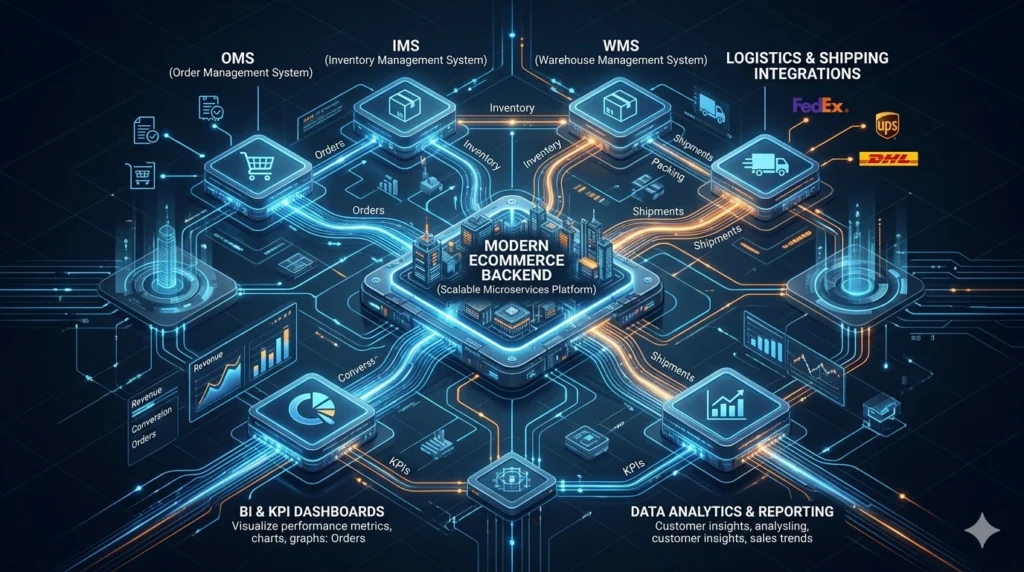
You don’t need to fix everything overnight. The most effective approach is to address visibility gaps systematically, starting with the highest-impact areas.
Step 1 — Map your current order journey end to end
Where does visibility break down? At fulfilment? At returns? At payment reconciliation?
Step 2 — Identify your biggest blind spots.
Which ecommerce operational inefficiencies are costing you the most — in money, time, or customer experience?
Step 3 — Connect your systems
Ensure your OMS, IMS, logistics partners, and customer support tools are feeding data into a central dashboard.
Step 4 — Set KPI thresholds and alerts
Don’t wait for a human to notice a problem. Automate alerts for when fulfilment SLA is at risk, inventory drops below threshold, or RTO rate spikes above your acceptable range.
Step 5 — Build a daily ops review habit
Visibility only creates value if someone is consistently looking at it and taking action.
Read More: Causes of High RTO in Ecommerce and How to Reduce It
Conclusion
Why ecommerce brands fail without operational visibility is not a mystery — it’s a pattern that repeats itself across hundreds of brands that had the right products, the right pricing, and even the right marketing, but couldn’t see their own operations clearly enough to fix what was breaking. Ecommerce data-driven decision making requires visibility as its foundation. Without it, even the best strategies fall apart in execution.
Whether you’re building your first ecommerce operations management systems or trying to fix a scaling operation that’s outgrown its infrastructure, the answer starts in the same place — get clear on what you can’t currently see, and build the systems to see it. That clarity is what turns operational chaos into scalable, sustainable growth.
Frequently Asked Questions (FAQs) Why Ecommerce Brands Fail Without Operational Visibility
1. What does operational visibility mean in ecommerce?
Operational visibility in ecommerce means having a real-time, centralised view of your entire operation — orders, inventory, fulfilment, returns, and logistics — without depending on manual updates or fragmented data sources. It allows you to identify and fix issues before they impact customers or margins.
2. Why do ecommerce brands fail due to lack of visibility?
Without operational visibility, ecommerce business visibility issues compound silently — inventory mismatches, fulfilment delays, and high RTO rates go undetected until they’ve already damaged margins and customer trust. By the time problems become obvious, they’re expensive to reverse.
3. What are ecommerce workflow tracking systems and why do they matter?
Ecommerce workflow tracking systems bring together order management, inventory, logistics, and returns into a single trackable flow. They automate alerts, reduce manual errors, and ensure every stage of the order journey has clear ownership and accountability across your operations team.
4. When should a brand consider hiring an ecommerce systems consultant in India?
If your brand is scaling past ₹50 lakh monthly revenue and still experiencing operational chaos, recurring RTO issues, or data inconsistencies across systems, it’s a strong signal to bring in an ecommerce systems consultant India to audit and restructure your operations stack properly.
5. How do ecommerce KPI tracking systems improve operational visibility?
Ecommerce KPI tracking systems surface real-time performance data across fulfilment, inventory, returns, and logistics. When set up with thresholds and automated alerts, they shift your team from reactive problem-solving to proactive operations management — which is the true foundation of ecommerce data-driven decision making.