There’s a specific kind of chaos that hits ecommerce brands between ₹20 lakh and ₹1 crore monthly revenue. Orders are coming in. The marketing is working. Customers are buying. And somehow, everything still feels like it’s held together with WhatsApp messages, manual spreadsheets, and sheer willpower. Fulfilment is delayed. Inventory numbers don’t match. Returns are tracked in someone’s personal notebook. The founder is still the one firefighting at 11pm.
This isn’t a people problem. It’s a systems problem. And the sooner you recognise that ecommerce backend systems for scaling are the actual foundation of sustainable growth — not better ads, not a bigger team, not another logistics partner — the sooner things start to change.
The Growth Phase Nobody Warns You About
Most ecommerce content is written for two stages: getting your first sales, or going from good to great at serious scale. The messy middle — where you’re growing fast but everything operational feels like it’s about to break — gets far less attention.
That phase is where ecommerce backend systems for scaling matter most. Not because systems aren’t important at other stages, but because this is the window where the cost of not having them becomes undeniable. Every order you process manually is a potential error. Every inventory count done by hand is a potential oversell. Every return tracked on a sheet is a margin leak waiting to be discovered too late.
The brands that get through this phase intact — that come out the other side with operations that actually match their revenue — are the ones that treated backend infrastructure as a growth investment rather than an afterthought.
What “Backend Systems” Actually Means
It’s worth being precise here because “backend systems” gets used loosely. When we talk about ecommerce backend systems for scaling, we mean the connected infrastructure that manages everything that happens after a customer clicks buy.
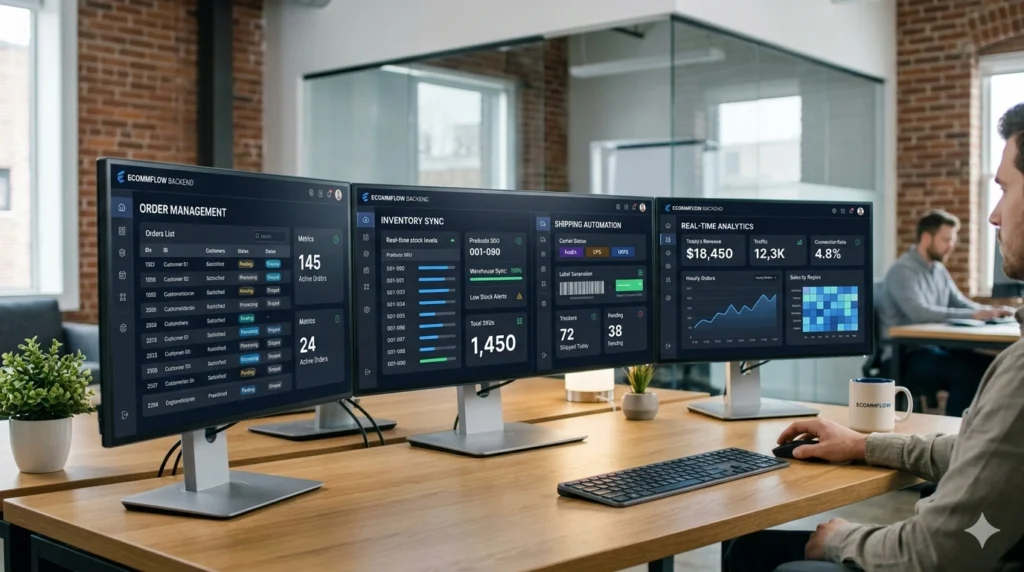
That includes your Order Management System — the single source of truth for every order across every channel. Your Inventory Management System — real-time stock visibility that updates automatically with every sale, return, and restock. Your Warehouse Management System — the operational layer that organises picking, packing, and dispatch at volume. Your shipping integrations — automated carrier selection, tracking updates, and exception management. And your returns workflow — not a manual process, but a structured system that logs, processes, and analyses every return.
Individually, each of these solves a specific problem. Together, they’re what backend infrastructure for scaling ecommerce brands actually looks like — a connected operational layer where data flows automatically, nothing falls through the cracks, and your team spends time on decisions rather than data entry.
The Real Cost of Running Without Backend Systems
Here’s the thing about operational gaps — they’re invisible until they’re expensive. Brands running without proper ecommerce backend systems for scaling don’t usually know what they’re losing until they do the maths.
Why D2C Brands Face a Different Backend Challenge
Overselling because inventory wasn’t updated in real time — that’s customer trust, negative reviews, and a refund processing cost on an order that should never have gone through. Manual order processing errors — wrong addresses, wrong SKUs, missed orders — each one costs more to fix than it would have cost to prevent. An untracked return that sits in a warehouse without being logged is dead inventory nobody knows about. A COD order that gets dispatched to a high-risk pincode because nobody flagged it is an RTO waiting to happen.
None of these sound catastrophic individually. But at 500 orders a day, each one multiplies. Ecommerce backend systems for efficiency improvement don’t just make operations smoother — they directly recover margin that was being quietly lost every single day. The impact of backend systems on ecommerce fulfilment performance shows up in every KPI that matters — from RTO rate to repeat purchase behaviour to customer lifetime value.
Marketplace sellers have some of this handled for them — Flipkart and Amazon provide fulfilment infrastructure, and the operational burden is partly absorbed by the platform. D2C brands don’t have that cushion. You own the entire operation, which means every gap in your ecommerce backend systems for D2C brands is entirely your problem to solve.
The advantage is that you also own all the data. When your backend systems are properly connected, every order tells you something — about which product is most likely to be returned, which geography has the highest delivery success rate, which customer segment has the strongest repeat purchase behaviour. That intelligence is yours to use.
Ecommerce backend systems for D2C brands need to do more than just process orders. They need to feed data back into the decisions that drive the business — pricing, product, marketing, and customer experience. When your operations infrastructure is connected, your entire business gets smarter with every order you process. That’s the compounding advantage that brands with strong backend systems build over time — and it’s why having the right ecommerce operations team structure for scaling D2C brands alongside your systems is what turns operational data into actual decisions.
What Ecommerce Backend Systems Automation Actually Unlocks
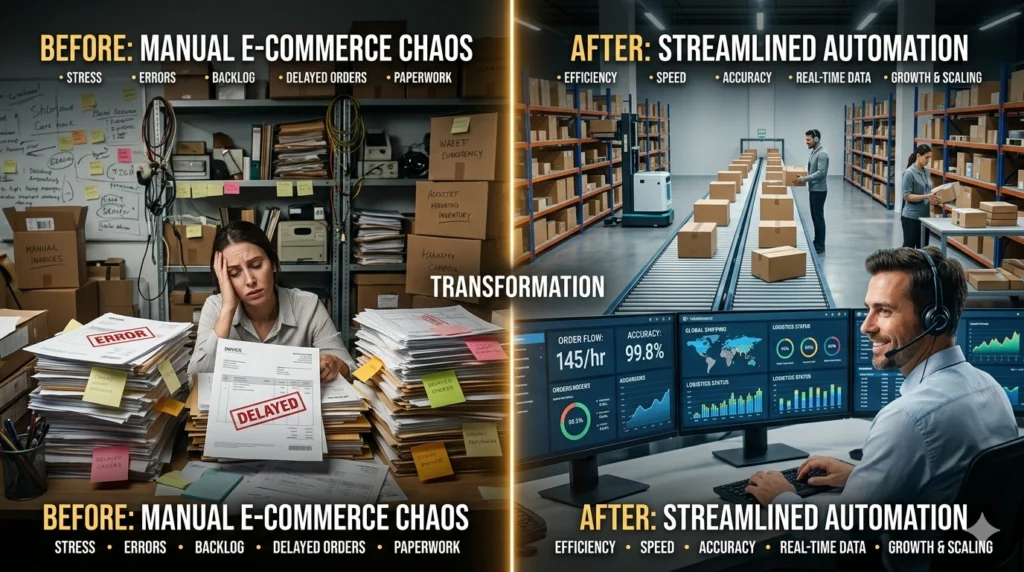
The version of automation most founders imagine is robots in a warehouse. The version that actually matters for growing ecommerce brands is quieter and more immediate — and this is exactly where ecommerce backend systems for scaling become critical.
Ecommerce backend systems automation means your OMS automatically routes every order to the nearest fulfilment centre based on pincode. It means high-risk COD orders are flagged before dispatch without anyone manually reviewing them. It means a return is initiated, logged, and tracked the moment a customer requests it — not when someone gets around to updating the sheet. It means low-stock alerts are triggered automatically when a SKU drops below the reorder threshold, not when someone notices it’s missing from the warehouse.
According to a McKinsey report on automation in retail operations, companies that implement operations automation see up to 30% reduction in cost per order and significantly faster order-to-ship cycle times. For ecommerce backend systems India brands operating at scale, that’s not a marginal improvement — it’s the difference between a profitable operation and one that grows itself into a cash flow problem.
Ecommerce backend systems automation is also what makes it possible to grow order volume without proportionally growing headcount. That’s the actual definition of scalable operations — handling 5x the volume without 5x the people, because the systems are doing the repeatable work.
Read More: Ecommerce Backend Workflow Systems
The Specific Places Backend Gaps Show Up as Business Problems
It’s worth naming these precisely, because founders often treat the symptom rather than the cause. Ecommerce backend systems for scaling are what actually determine whether these issues persist or get solved at the root level.
Rising RTO rate — often blamed on logistics partners, but frequently caused by no pre-dispatch risk flagging in the backend. Inventory discrepancies — blamed on the warehouse team, but caused by no real-time sync between the OMS and IMS. Slow fulfilment — blamed on staffing, but caused by no WMS creating structured pick-and-pack workflows. High WISMO queries — blamed on customer behaviour, but caused by no automated tracking update system pushing proactive communication.
Every one of these is a backend systems problem wearing a different costume. And every one of them is fixable — not by working harder, but by building the right backend infrastructure for scaling ecommerce brands that removes the human bottleneck from processes that should be automated.
Ecommerce backend systems for efficiency improvement don’t just reduce errors — they shift your team’s entire energy from reactive to proactive. Instead of chasing problems that already happened, they’re watching dashboards that show problems forming — and intervening before the customer is affected.
Read More: Causes of High RTO in Ecommerce and How to Reduce It
How to Build Backend Infrastructure Without Overcomplicating It

The trap most growing brands fall into is trying to build everything at once. They look at what a large brand’s backend looks like and try to replicate it — and end up with a half-integrated tech stack that creates new problems while solving old ones.
The smarter approach is sequential. Start with the system that solves your most expensive current problem. For most brands in the ₹30–80 lakh monthly revenue range, that’s either the OMS or the IMS — whichever one is causing the most visible operational pain.
Get that right first. Build the integrations. Train the team on the new workflow. Let it stabilise. Then add the next layer. Ecommerce backend systems India brands that scale successfully almost always did it this way — one solid system at a time, each one integrated with the last, building toward a connected operational layer rather than trying to buy their way there all at once.
The other thing that makes backend systems actually work is pairing them with clear processes. Technology without process just automates the chaos. The brands that get the most from ecommerce backend systems for scaling are the ones that documented their workflows before they automated them — so the system is doing the right thing quickly, not just doing things quickly.
Conclusion
Ecommerce backend systems for scaling aren’t a future investment for when you’re bigger. They’re the reason you get bigger in the first place — and the reason you stay there without breaking. Ecommerce backend systems India brands that are winning operationally didn’t build their infrastructure after they scaled. They built it in anticipation of scale, and that foresight is what made the growth sustainable.
Whether you’re crossing 300 daily orders or pushing toward 3,000, the question isn’t whether you need backend infrastructure for scaling ecommerce brands. You do. The question is whether you build it now, on your terms, with a plan — or later, in a crisis, when it costs three times as much and the brand reputation is already paying the price.
Frequently Asked Questions (FAQs) Ecommerce Backend Systems for Scaling
1. What are ecommerce backend systems and why do they matter for scaling?
Ecommerce backend systems for scaling are the connected operational infrastructure — OMS, IMS, WMS, logistics integrations, and returns management — that manage everything after a customer places an order. They matter because manual processes that work at low volume break down fast as orders grow, and the cost of those breakdowns compounds directly into your margins and customer experience.
2. When should a D2C brand start investing in backend systems?
Before the operational pain becomes a crisis — ideally around 150 to 250 daily orders. At that volume, the inefficiencies of manual operations are already costing you money. Waiting until you’re at 1,000 orders a day means you’re rebuilding a moving vehicle, which is significantly more expensive and disruptive than building ahead of the problem.
3. What does ecommerce backend systems automation actually include?
Ecommerce backend systems automation covers order routing, pre-dispatch RTO risk flagging, automated tracking updates, return initiation workflows, payment reconciliation, and low-stock alerts — essentially any rule-based, repeatable operational task that currently requires manual input. The goal is to free your team from data entry and exception management so they can focus on decisions.
4. How do backend systems help reduce RTO for Indian ecommerce brands?
Properly built ecommerce backend systems India brands rely on can flag high-risk COD orders before dispatch, track return patterns by SKU and pincode, and automate return processing to reduce the time and cost of every undelivered order. Most rising RTO problems aren’t logistics failures — they’re backend visibility failures that a good system catches early.
5. Do small ecommerce brands really need backend infrastructure or is it only for large brands?
The ecommerce backend systems India market now has scalable, accessible tools at every price point. You don’t need an enterprise budget to build solid backend infrastructure for scaling ecommerce brands. Starting with one well-integrated system — your OMS or IMS — and building from there is both affordable and significantly more effective than waiting until scale forces your hand.